Sunday night, after a family get-together with fajitas, charro beans and cake. A couple of hours later a dull ache settles in right under your ribs on the right side. It isn't a cramp that comes and goes; it's a steady, squeezing pain that sometimes wraps around to your back or up to the tip of your shoulder blade. You lie on one side, then the other, and nothing helps. Somewhere around 3 a.m. it eases off by itself, and the next morning you're left wondering whether it was the food, trapped gas or something else.
We hear some version of that night all the time, and quite often the gallbladder turns out to be involved. Below we go through how that pain usually behaves, what gets mistaken for it, what an abdominal ultrasound can show and when waiting is a bad idea.
What sits under those ribs
The upper right part of your belly is crowded. The liver is there, along with the gallbladder (a small pear-shaped pouch tucked under the liver), the ducts that carry bile to the gut, the first stretch of the small intestine and, further back, the right kidney. Just above, on the other side of the diaphragm, sits the bottom of the right lung.
That's why pain in this spot can come from several places. The gallbladder is a common suspect, especially when the pain follows a meal, but it isn't the only one. Pointing to the exact spot helps, yet what tells the medical team the most is how the pain started, how long it lasts and what comes with it.
How gallbladder pain tends to act
The gallbladder stores bile, a fluid that helps break down fat. After a heavy meal it squeezes to release that bile. If it holds stones (gallstones), one of them can plug the exit for a while and set off what's called a gallbladder attack, or biliary colic. MedlinePlus describes the usual pattern:
- Steady pain in the upper right or upper middle belly, just below the breastbone
- Often starts within a few hours of a large or fatty meal
- Lasts from about half an hour to several hours, then fades
- Spreads to the back or the right shoulder
- May bring nausea or vomiting
- Can strike at night and wake you up
Plenty of people have gallstones and never feel a thing; the stones only turn up on a scan done for another reason. Trouble begins when they start causing symptoms.
Matching what you feel to what it might mean
This table won't diagnose you at home, but it helps you describe your symptoms clearly once you're in the exam room:
| What you notice | What the medical team may consider |
|---|---|
| Pain after a greasy meal that goes away within hours | A gallbladder attack from stones |
| The same pain, lasting many hours, with fever | An inflamed gallbladder: go to the ER |
| Yellow skin or eyes, cola-colored urine, pale stools | A stone blocking the bile duct: go to the ER |
| Hurts when you twist, take a deep breath or press one spot | A strained muscle or a rib |
| Burning that rises into the chest and gets worse lying down | Acid reflux or an irritated stomach |
| Pain moving toward the groin with burning when you pee | A kidney or urinary problem |
Three stories we hear a lot
These are blends of what many patients tell us, not any one person's case.
A 52-year-old woman from Champions has had what she calls heartburn for months, but only on weekends and always after big meals. Antacids barely touch it. The telling detail: the discomfort never climbs into her chest. It stays under her right ribs and reaches around to her back.
A 34-year-old woman dropped a lot of weight fast on a very strict diet. Rapid weight loss is one of the factors the NIH links to gallstones forming, and her pain began during those same months.
A 47-year-old man with diabetes feels pressure in his upper belly when he eats late. With him, the medical team also asks about shortness of breath, cold sweats or pain spreading to the arm, because in people with diabetes a heart problem can show up as pain in the pit of the stomach.
Who is more likely to form stones
NIH patient resources list being female, being over 40, carrying extra weight, pregnancy, losing weight quickly, diabetes, a family history and Mexican American or Native American heritage among the common risk factors. Having one or several doesn't mean you have stones; it simply makes symptoms worth checking. If you're already managing diabetes or high cholesterol, your chronic condition care visit is a good time to bring up pain after meals.
What the abdominal ultrasound looks at
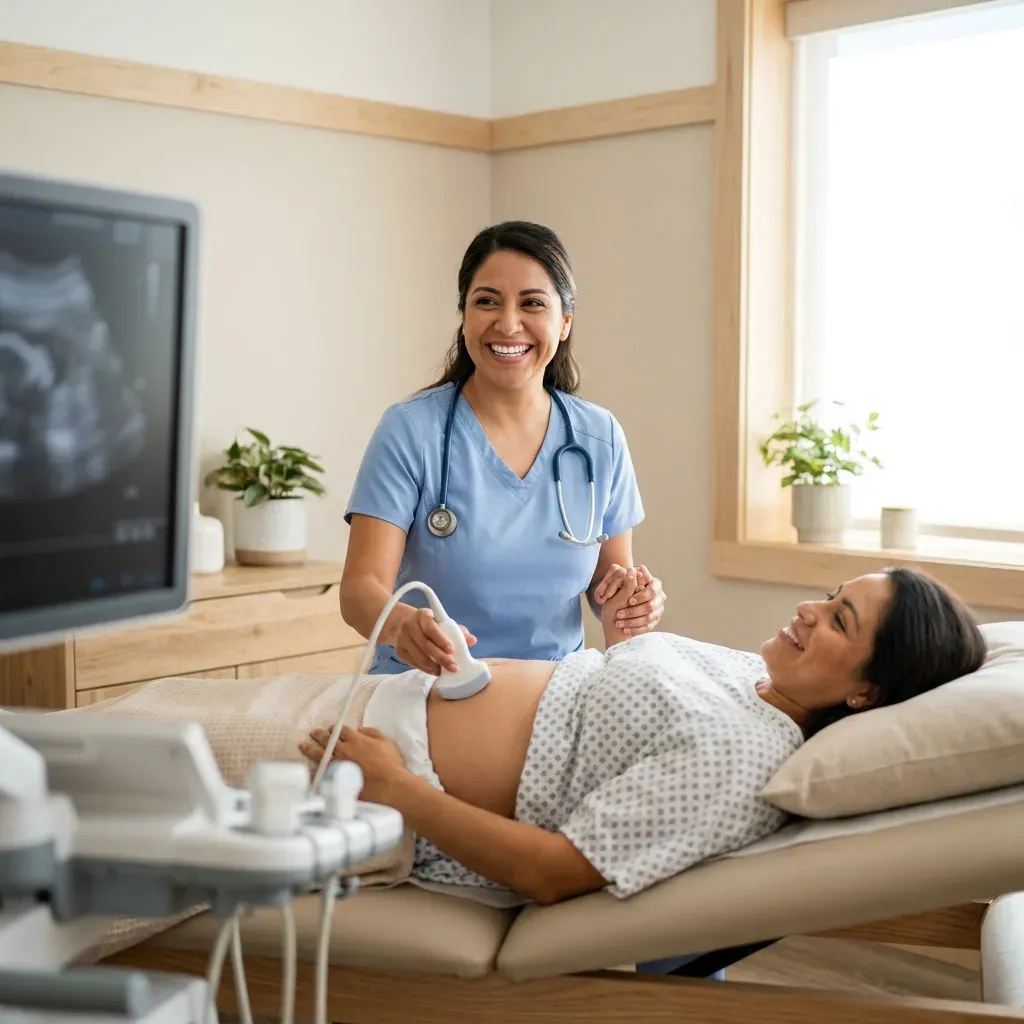
The abdominal ultrasound we do at the clinic shows the liver, gallbladder, kidneys and other organs in the belly, with no needles and no radiation. For right-sided pain, it's a way to look for stones inside the gallbladder and see how the surrounding structures look. As the probe glides over warm gel, you may feel some pressure under your ribs, and you might be asked to take a deep breath and hold it for a few seconds so the gallbladder drops into view.
We explain what we see in Spanish or English. Even so, images don't interpret themselves: the medical team puts them together with your story, a hands-on exam of your belly and, when it's needed, liver function blood tests. If your case calls for another scan or an evaluation by a specialist, the medical team guides the referral.
Why the fasting matters
For this scan, plan on not eating for a few hours beforehand. There's a real reason: after a meal the gallbladder empties and shrinks, and a small, collapsed gallbladder is much harder to examine. Since every scan has its own prep, call ahead to book a time and find out how many hours of fasting apply to you. A top and pants work better than a dress, so you only need to uncover your belly.
Keep a one-week pain log
Before your visit, jot down each episode on your phone:
- The day and time it started and how long it lasted
- What you ate in the hours before
- Where the pain traveled (back, shoulder, chest)
- Any fever, chills, nausea or vomiting
- The color of your urine and stools around that time
- Every medicine, vitamin and herbal tea you take
If there's any chance you're pregnant, tell the medical team; a pregnancy test can be part of the same visit.
While you wait for the scan
Several small meals usually sit better than one huge dinner, and cutting back on fried and very fatty food helps. Skip the olive oil and lemon "gallbladder flush" that keeps going around on social media: it doesn't dissolve stones and can bring on vomiting and more pain. And don't keep upping the painkillers to get through attacks that are getting longer.
Signs that mean skipping the scan and heading to the ER or 911
Don't wait for the ultrasound if you have:
- Severe pain that doesn't let up after a few hours or keeps you from staying still
- Fever or chills along with the pain
- Yellowing of the skin or the whites of the eyes
- Vomiting that won't stop and keeps you from holding down fluids
- Chest pressure, a cold sweat or trouble breathing, even if the pain seems to be in your belly
If the pain keeps coming back after big meals
An attack that repeats is a sign it's time to take a look. At our Kuykendahl clinic in north Houston (77090), call (281) 789-0484 to set up your abdominal ultrasound, and come in with the right fasting window and your pain log ready.
Need medical attention?
We're here to help. Call now to schedule your appointment or visit our clinic without an appointment.
Call now: +1 (281) 789-0484